I guess this has turned into an occasional blog — since I'm not exactly a prolific writer, I'll most likely continue writing whenever issues raise their heads (instead of daily/weekly/monthly...). So — I came upon a situation this past semester that was a new dilemma for me, after all these years, and I am still wondering how I could have handled it better, and how I can tweak my class projects in order to head off anything similar in the future...
In the past, at EOSA, I had given my Dance Production students very specific assignments for their final choreography projects for the spring concert (one year it was dance in the style of a dance ancestor, another was dance as a response to history or social issues, another was dance responding to words or text, etc.). This year, for my first Dance Production class at my new school, I reverted to the more open-ended system of my student-teaching mentor — each semester we had an "idea day" in which students presented their dance ideas to the class; then dancers signed up for dances they most wanted to perform, choreographers gave me lists of their needs for dancers, and I set casting accordingly.
This worked beautifully in the fall concert, with 11 choreographers presenting interesting pieces in widely varied styles. In the spring, we again had some intriguing ideas presented; but I also noticed a lot of choreographers talking more about the popular music they wanted to dance to than the dance itself. Of more concern were various references to "hardcore popping" or "burlesque-style" dance, as well as some of songs that were fairly offensive (in which bouncing, jiggling, and showing off your booty is the entire point) — the tone of the day felt to me as if some choreographers were competing for dancers by using popular and sexualized songs and movement. So I reconnoitered, told the choreographers to come back in a week with a written proposal including what they intended to communicate to the audience, and tried it again. The second idea day went better — most choreographers came back with complete proposals, with more well-thought-out movement ideas and nothing overtly unacceptable at least.
As we moved into rehearsals and in-progress showings, I could see there were still a couple of dances (or parts of dances) that made me uncomfortable as a director. The first was pretty simple: in a group dance about love, the very first movement looked to me like stereotypical "stripper dance" — dancers squatting on their heels opened their knees sharply in unison before slithering to standing level (a movement which undoubtedly appears in countless music videos, but in context seemed very suggestive). I talked to the choreographer about what she intended to convey to her audience, how the opening movement sets the tone for the whole dance, and that at least parts of her audience were likely to see her beginning as an allusion to striptease. She agreed that it might not be the most appropriate opening, and changed it so that each dancer (still in unison) sharply made his or her own dramatic, low-level shape — which turned out to be a much more interesting opening in any case.
The second instance was more difficult. This choreographer had originally proposed one of those "shake your body" songs; for her second proposal she changed to "Flawless" by Beyoncé. Ironically — given that the song includes a talk by the writer Chimamanda Ngozi Adichie on the importance of feminism, specifically deploring girls in our culture competing for the attention of men — her dance seemed to be permeated with subtly (or sometimes overtly) sexualized movement. After the first showings I asked her to tone down some parts of the dance, which she did (though reluctantly); but it remained problematic for me —not blatantly inappropriate enough to take it out of the concert, but still not what I wanted to showcase in my dance program.
The heart of my dilemma is that this choreographer's intention was to create a dance about "empowering women to love their own bodies" (as her dancers agreed). I think these young women genuinely believe they are conveying women's empowerment by performing movement that looks to me very reminiscent of striptease. I know this style of movement is very much a part of pop culture through music videos, and that burlesque and even pole-dancing are now popular recreational dance classes; yet I also know, in a historical context, how much this is still a product of a male-dominated culture in which women are objectified as sex objects. What I have been asking myself is: how do I expand my students' focus (or raise their consciousness, as we used to say) to understand how these movements they are drawn to are objectifying, decidedly un-empowering, and borderline offensive for some of us, without coming off sounding like an anti-sex prude? I worry that I am simply being too sensitive — but I do not want my (nearly all female) students learning to demean and objectify women, however inadvertently.
This, again, is a new problem for me — at my previous school, every student in my (small) Dance Production classes presented their choreography finals on stage, and somehow I never had to deal with movement I considered inappropriate.... So I wonder — has the culture changed that much? Is it something in the culture of this particular school? And how do I adjust my class to prevent the problem in the future — going back to specific assignments? Requiring instrumental music only? (both of which I am definitely toying with.) Or perhaps some readings in classic feminist literature...? Or do I just frankly talk to the new class about how sexualized movement objectifies women? I hope that these are just growing pains of a new program and that we will get over it as our culture of dance develops, but I do feel a need to address it proactively as the new school year starts.
Showing posts with label dance ed concepts. Show all posts
Showing posts with label dance ed concepts. Show all posts
Wednesday, July 27, 2016

Thursday, April 7, 2016
new rubrics (part 2)
The second new rubric I needed to create last fall was for the Dance Production class: since we were working with a new (for me) class structure, I needed a new rubric to assess the final choreography projects. In my previous DP classes at EOSA, there had always been a final choreography assignment with specific guidelines; but this year's open-ended structure, with choreographers signing up to create whatever they envisioned, demanded a new assessment structure as well.
So I went back to the beginning — I started by looking at the peer critique form from my student teaching mentor (Marcia Singman at Berkeley High), which asked students to look for variety in dance elements, use of stage space, entrances and exits, and the like. Choreography feedback guidelines from Mills College were also helpful, stressing dance elements as well, but also originality, willingness to take risks, clarity of ideas, and attention to detail — all things which I value and want to see in my students' choreography. I looked a little farther afield and found a a few choreography rubrics online, which gave me ideas for some specific things to include in various categories... then to put it together!
I began with a couple of categories that are standard in my rubrics for group choreography projects in class: "Dance structure" and "Creativity and Variety." In ordinary choreography projects, I use "Dance structure" to stress the point that all dances have a beginning, middle, and end (as well as well-planned sequences and transitions), and that the beginning and end are vitally important as the first and last thing the audience sees — so students know they lose points for just standing in neutral waiting for the beat, or dropping the last movement or shape and walking away. For the Dance Production projects, it was a given that no choreographer was going to put a piece on stage without some kind of beginning and ending, so I added language to indicate whether the beginning and ending were clear but uninspiring, strong, or dynamic; and that the dance has a clear flow and sense of purpose. Then since "creativity" could fit into this rubric in may forms, I converted the general "Creativity and variety" category into the more specific "Variety and contrast" — use of variety in the dance elements of space, time, energy, and relationships. Harking back to Ms. Singman's work, I also inserted a category for "Use of stage space" (including entrances and exits). Those three categories took care of the purely "craft of choreography" aspects of the rubric.
Of course, creating a rubric is still an exercise in setting — or simply recognizing — priorities and values. My goal for years has been to move students beyond setting their favorite steps to their favorite songs, and toward expressing and communicating meaning, so much of the remainder of the rubric is concerned with how student choreographers are (or are not) finding original ideas and bringing meaning to their works. For this I turned back to the Mills College guidelines. I made one category focusing on originality — this is where I brought in movement invention versus movement clichés as well as willingness to take risks. For the category most specifically focused on communicating meaning I chose the title "Artistic intention," which allowed me to bring in not only what the dance is intended to communicate (whether ideas, emotions, a narrative, or simply a mood), but also whether the dance demonstrates the choreographer's artistic growth — which I realized, as I worked on this, is also one of my high priorities.
Those categories added up to 90 points, so I completed the rubric with a 10-point category for "Attention to details." This gave me the chance to bring in the dancers' performance of the piece in a relatively small way. In our ordinary in-class group choreography projects, preparation and performance quality are graded as a part of the project — since the group works together as a whole, the dancers' preparation, confidence, and attention to details of technique do generally reflect how hard the group worked on the assignment. In this case, I was focused on assessing the choreography itself, not the dancers' performances; but I did feel that attention to detail among the dancers (precision of movements and shapes, floor patterns, and relati onships) shows something about how the choreographer worked with the group, so I found that it was appropriate to include.
That rounded out my rubric — here it is, I would welcome any feedback!

Tuesday, March 15, 2016
new rubrics (part 1)
In the course of the fall semester I developed a couple of new rubrics and put them to use. A good rubric can be invaluable in organizing your thinking to make the process of grading a physical art form as objective as possible. Over the years, I've come to realize that creating a rubric is an exercise in deciding what is important, what you truly care about seeing and consider excellent; and this process was certainly no exception.
The first new rubric was for performance tests. The rubric I had used and revised over many years had up to five categories (three or four for minor tests): Preparation/sequence, Energy, Technique, Musical timing, and Focus/stage presence. Here is that one:

As I was grading my spring performance finals, I grew more and more dissatisfied with the categories. "Preparation / sequence" was pretty straightforward (ranging from "solid enough to lead the rest of the dancers" to "lots of mistakes or completely dependent on other dancers"), as was "Focus" (taking into account things such as engaging with the audience, covering mistakes, and staying in character). But "Energy" felt a bit problematic, as "advanced" in that category — "full-out performance with excellent energy" — often seemed to be not quite what I was looking for in many dance styles. "High energy" would not come close to describing the subtle energy dynamics of 'auana hula, for just one example. So I started to think in terms of the dance element Energy and all it entails — smooth vs. sharp, weight, tension, flow, movement qualities — and moved that category more in the direction of using force and energy appropriate to the dance form.
I had also had trouble with the "Technique" category for years — I had started out including things like "clean lines, precise footwork, arms and legs stretched and feet pointed" as examples of attention to technical details, but ended up again feeling that my wording did not cover what I was looking for, as stretched arms and pointed feet are not necessarily a part of good technique in all dance forms. So I remembered something my mentor Patricia had said years ago (in relation to teaching creative work versus teaching technique): "after all, what is technique if not the elements of dance, applied?" That set me thinking that what we ordinarily think of as technical skill includes the energy dynamics and musical timing that I had broken out into separate categories... And then it started to click: so what was it that I was really looking for (what was important to me) in that category I called "technique"? Of course — shape! All those years, when grading "technique," I had really been most concerned with students creating the shapes appropriate for the dance form (which may include those pointed feet... or not). And if I started to think more broadly about Space, then amplitude, facings, and so many other things I had neglected to include would be covered...
From there, it was an easy jump to realizing that I simply needed to base my rubric on the elements of dance. It would still contain five categories, as the Preparation and Focus categories would remain; but the other three would reflect Space, Energy, and Time. Here is what I came up with:
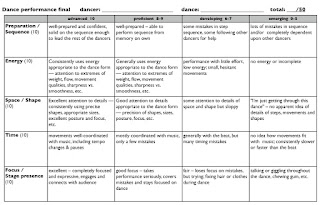
I used the new rubric for all the fall semester performance finals, and it did work much better for me — no longer was I looking at details which seemed to fit into more than one category and having to decide where to note them. I found I could be much clearer in my thinking, now that I had acknowledged what I had really been looking at all along!
Of course, all rubrics are works in progress, so I will continue to refine this one...
The first new rubric was for performance tests. The rubric I had used and revised over many years had up to five categories (three or four for minor tests): Preparation/sequence, Energy, Technique, Musical timing, and Focus/stage presence. Here is that one:

As I was grading my spring performance finals, I grew more and more dissatisfied with the categories. "Preparation / sequence" was pretty straightforward (ranging from "solid enough to lead the rest of the dancers" to "lots of mistakes or completely dependent on other dancers"), as was "Focus" (taking into account things such as engaging with the audience, covering mistakes, and staying in character). But "Energy" felt a bit problematic, as "advanced" in that category — "full-out performance with excellent energy" — often seemed to be not quite what I was looking for in many dance styles. "High energy" would not come close to describing the subtle energy dynamics of 'auana hula, for just one example. So I started to think in terms of the dance element Energy and all it entails — smooth vs. sharp, weight, tension, flow, movement qualities — and moved that category more in the direction of using force and energy appropriate to the dance form.
I had also had trouble with the "Technique" category for years — I had started out including things like "clean lines, precise footwork, arms and legs stretched and feet pointed" as examples of attention to technical details, but ended up again feeling that my wording did not cover what I was looking for, as stretched arms and pointed feet are not necessarily a part of good technique in all dance forms. So I remembered something my mentor Patricia had said years ago (in relation to teaching creative work versus teaching technique): "after all, what is technique if not the elements of dance, applied?" That set me thinking that what we ordinarily think of as technical skill includes the energy dynamics and musical timing that I had broken out into separate categories... And then it started to click: so what was it that I was really looking for (what was important to me) in that category I called "technique"? Of course — shape! All those years, when grading "technique," I had really been most concerned with students creating the shapes appropriate for the dance form (which may include those pointed feet... or not). And if I started to think more broadly about Space, then amplitude, facings, and so many other things I had neglected to include would be covered...
From there, it was an easy jump to realizing that I simply needed to base my rubric on the elements of dance. It would still contain five categories, as the Preparation and Focus categories would remain; but the other three would reflect Space, Energy, and Time. Here is what I came up with:

I used the new rubric for all the fall semester performance finals, and it did work much better for me — no longer was I looking at details which seemed to fit into more than one category and having to decide where to note them. I found I could be much clearer in my thinking, now that I had acknowledged what I had really been looking at all along!
Of course, all rubrics are works in progress, so I will continue to refine this one...
Friday, October 23, 2015
NDEO conference
I recently returned from the NDEO (National Dance Education Organization) annual conference – the first I have attended in three years, since I will not fly (if you’re curious, here is why), and so I only get to it when it rotates to the west coast, in train or bus range. As usual, it was completely rejuvenating and inspiring (although the travel to and from Phoenix was a bit tiring), and I came back with so many ideas to try out on my classes!
There were many wonderful sessions, most incredibly useful for my teaching practice, some simply restorative and interesting to me as a dancer and dance scholar. I was thrilled to be able to take a modern dance class (“for the maturing dancer”) from Anne Green Gilbert, one of the mothers of creative dance education – it was lovely to warm up with the Brain Dance, right from the source, and to see how she combined work on energy qualities with Bartenieff floor work and technique combinations.
One highlight of the conference for me was a presentation by Ann Hutchinson Guest, a preeminent dance historian and authority on notation and a true grande dame of the dance education community, on reviving a ballet choreographed in 1844 by Arthur Saint-Léon from his own notation. Contrary to how we often think of 19th century Romantic ballet – ethereal ladies in white dresses floating effortlessly and fluidly across the stage – this dance turned out to be extremely vigorous and virtuosic, full of sissones, entrechat-six, and straight-leg pas de chats. As part of the session we were taught a few phrases from the dance — simpler phrases for the corps dancers, not the virtuosic solo variations — and their difficulty (even for the youngsters among us) was an eye-opener. Another surprise was a variation in which the lead ballerina (Fanny Cerrito in the original) stayed on pointe for the entire length of her solo. I have always heard that in the early days of pointe work, ballerinas would only rise to the tips of their toes for brief moments, since they were dancing in nothing more than soft ballet slippers with a little extra darning around the toes, not the hard boxes of fabric and glue we are familiar with today... yet this variation (recreated faithfully from the original notation) kept the ballerina on her pointes, performing posé arabesques, chainé turns and the like, for at least a minute. Ms Cerrito must have had incredibly strong toes!
Another highlight was a session I attended on my first day, called "POP! From Literal to Abstract." We were taken through a project (designed for undergrads, but just as applicable to high school dancers) that ingeniously combatted the tendency of young choreographers to depend on following pop song lyrics for generating movement ideas. We were broken into small groups, and each group was given a printout of lyrics to a popular song. We were then tasked with interpreting those lyrics as literally as possible. The results were often hilarious... Our group drew the song "Toxic" by Britney Spears, and creating movement from the lyrics felt almost like playing charades — miming shooting up drugs for "I'm addicted to you" and throwing a pair of dice for "paradise"; and of course miming rocking a baby showed up in multiple groups ("baby. baby" is pretty ubiquitous in pop songs). The humor, of course, is the point — though students often use rote, clichéd gestures as a jumping-off point, when forced to go so far overboard with the idea they often begin to see the stale and vapid choreography that emerges for what it is.
Phase two of the project is to leave aside the lyrics completely, to take the gesture dance created in phase 1 and to abstract all of those gestures (using the usual devices — size/range, tempo, level, body parts / instrumentation, etc.) — working without music, of course. The results of this part of the project were equally enlightening, as the abstracted dances turned into some lovely and original compositions. If we had had more time, it would have been interesting to see them again, set to the original songs, to see how the juxtapositions might have turned out.... but what we did (in only an hour!) was plenty. I left the session knowing that this is a project I must give to my Dance 2 and Dance Production classes this year — preferably before they start composing dances for the final concert!
Tuesday, April 7, 2015
class dance project
Wow — things have gotten very busy and I haven't posted in over a month! I guess I have a bit of catching up to do...
Since completing our brief Polynesian unit with a bit of Tahitian, I gave the classes a short choreography project to create a phrase for a class dance. This is an assignment I had only given a couple of times before, and which I was a little hesitant about, as it doesn't reinforce any specific dance elements — but it does give the students a chance to create the phrases they've wanted to create since the beginning of the year (and, as I have to admit, perhaps help to get them hooked on the idea of taking Dance again next year). The idea is very simple: create a short dance phrase (24 - 32 musical beats) that you would like to teach to your classmates, which we will then combine into a class dance. The only real requirement was that the movements be the students' own creation (no direct-from-video choreography please!).
A few interesting things came up in this one for me... One was that, as I watched groups working on their steps, I noticed an awful lot of dependence on song lyrics for movement ideas — things like the ubiquitous gesture for “call me” (thumb and pinkie stretched from ear to jaw), what I think of as “Mickey Mouse-ing” the song (of course, could have headed this off by requiring instrumental music again, but part of the impetus for this project was to let the kids work with the music and movements they’ve wanted to work on all along). One of my thoughts on this was that we had just recently learned Hawai’ian dance, in which the gestures explicitly illustrate the words of the song, and I wondered how their movements might have differed had we done this at another time; but I think in some respects this way of thinking about songs and gestures is so natural for them it may not have made a difference.
Ironically (given how hesitant I was about the assignment to begin with), this turned out to be one of our more successful choreography projects. Everyone participated, and all groups successfully taught their phrases to the class — some with their own spokesperson, some using me to transmit their steps using “loud teacher talk”... Students were eager to learn from each other, and although they did tend to be more talkative and less focused when their peers were teaching than they usually are with me, they were invariably supportive and enthusiastic about their classmates’ work — and picked it up very quickly, to boot. With a good mix of styles, tempos and energies, each class now has one more dance to add to their repertoire for the end of the year.
Before leaving for spring break, I assigned a journal reflection on the project — How did you feel about teaching your movement to the class? Did the knowledge that you would be teaching your steps change your creative process? What was hardest for you in this? How did you feel about learning movement from your classmates? Which group surprised you, and why or how? The responses were overwhelmingly positive — many students said they thought they would be too scared to teach, but they gained confidence and pride as they saw their peers learning their movement... I had originally thought of this as a project just for the first year of the program (essentially to give each class that one more repertoire piece for the end-of-the-year concert); but after seeing what a confidence-builder it became, I think I may need to bring it back in future years — perhaps with just a few tweaks to get them over that song-lyric rut!
Wednesday, February 11, 2015
reflections on the tempos project
I got behind on my writing as I spent a good chunk of last weekend and quite a few evenings ensconsed with my video camera and choreography rubrics, grading the tempo variations projects... But after viewing twenty-one projects (many times each), I think I can at least say I am encouraged with the results of some adjustments in the way I've been teaching it over the years.
When I first started assigning this project, way back in my student-teaching days, it was very cut-and-dried: create a 16-count movement phrase and perform the same phrase in three tempos: medium, half-time, and double-time. From this, I think students learned what half-time and double-time were — but not really very much about varying tempo for choreographic effect. In the intervening years, I had tried broadening the project by simply requiring three distinct tempos, but students often wound up with movements only marginally slower or faster (sometimes they would even ask if they could mix three songs, in slightly different tempos, so that they could stay "on the beat"). This time I did allow them to use three tempos any way they liked, but stressed very strongly how extremely different they should be ("think s-u-p-e-r slow-mo"... "think hyperspeed!").
I also expanded just a bit on the lead-up creative work this year — for many years in the past, I would give one creative-work lesson on tempo/speed, then follow up the next day by trying already-learned dance phrases in double-time and half-time; but this time I used two days for creative work on speed. And, of course, the third major change was restricting them to instrumental music.
It's hard to say which of these adjustments made the difference (probably a combination of all three), but this was the first time that I saw almost all groups using tempo variations, clearly and purposefully, the way they should be used: to make choreography more interesting and engaging. Nearly all groups clearly showed three very distinct tempos, and nearly all mixed them in some unique ways. Even groups who haven't yet gained the skill or confidence for full-out, polished performances created some lovely little studies... One group juxtaposed a slow body roll with a fast, accented arm movement in a repeated pattern; another repeated their opening movements at the end of their dance in slow-motion, creating unity and variety long before I taught the concepts; still another began their dance with slow, curling hand movements, reflected those movements with undulating torsos, then kept repeating hand and torso movements in increasingly fast tempos until they ended with fast shoulder isolations.
So... while it would be tempting to think that I simply taught the project so well this year that my students really got it for the first time, my suspicion is that what actually made the most difference was the instrumental music. I'm remembering back to when we first did the ancestors project at EOSA, and how being required to work in a new style jolted those dancers out of their hip-hop-and-Cumbia comfort zones and into an entirely new level of choreography — and I think perhaps in much the same way, having that crutch of their favorite songs taken away gave these students the freedom to think about their movement in a new way. In that case, I may have just found a good progression of projects to start my Beginning Dance classes: starting off with directions and facings, an easily accessible project danced to their requested songs, letting them begin the year in their comfort zone so as not to scare them off; then the Symmetrical and Asymmetrical Shapes project, danced to amorphous music to break them out of their comfort zones; then the tempos project, requiring instrumentals to help them continue growing and risking new ideas... We'll see how it goes from here!
Saturday, December 20, 2014
End-of-semester dilemma
Planning the end of this semester turned out to be a bit of a dilemma for me. Coming from Oakland, I was used to having two weeks after winter break before finals — ample time for a few improv lessons and a final choreography project. Most of my years at EOSA, my fall semester final was a dance mapping and notation project: after leading in with the map activity then practice describing steps and movements, groups would notate their own choreography using dance vocabulary, musical beats, and pattern maps.
After attending a wonderful workshop on the Language of Dance (LOD) this fall, I got excited about trying the project in a whole new way. In the workshop, we learned a few basic LOD symbols (shape, travel, turn, spring, flexion, extension, stillness) and how to use them in a timeline; we then created solos by arranging the symbols as a starting point. It was an engaging new way of working for me, so I planned to try turning that notation part of my usual assignment upside-down — instead of first choreographing steps and then notating them with descriptions, my students would arrange the LOD symbols to build their dances, and only then fill out the movement physically. I was anxious to try out the project in a whole new way...
Unfortunately, my new district starts and finishes the school year (and fall semester) one week earlier, leaving only one week after winter break to prepare for finals. It just felt too weird to me to have a two-week vacation in the middle of a creative work / choreography project; to top it off, I would also be missing all of my sophomores (about half the students in all my dance classes) for testing during two days of this week, making it even harder to feel that we had time to do a notation and mapping project justice. So I somewhat reluctantly decided to switch gears entirely and have a performance final instead, letting students choose one or two of the dance styles we have studied this semester (basic jazz, the Thriller jazz dance, and Lindy hop / Big Apple) to perform in class — which they could easily review in the one week after break. In the meantime, we could still work on some of the mapping and LOD concepts this week.
What feels uncomfortable for me in this is that I’ve only gotten my classes through two choreography projects this semester. There are a number of reasons for that — for one, we started the school year two weeks late, then took an extra two weeks out of the curriculum to work on the Thriller dance (which was entirely worth it, both for making the program visible and for student buy-in); we also took longer on both creative work units than I have in the past, for the sake of allowing enough time to not rush the choreography — but in that “technique vs. creative work” dichotomy, the creative work seemed to be falling behind.
On the other hand, what came out of the dilemma was perhaps a new way of thinking about teaching creative dance and improvisation for me. In the past, the bulk of my creative dance lessons have been connected to a few elements, as lead-ins to group choreography projects; but this week, we were able to do four days of creative work for its own sake, not tied to a project, and that actually felt very freeing. We did dance mapping and a brief introduction to the LOD symbols and timeline (which I hope to return to in small ways throughout the year), as well as a two-day duets project for the small classes while the sophomores were out testing (more about all those lessons in the next post). I now think that this is a direction that I can and should explore further — while I surely will continue to teach creative work units, with specific lessons leading into choreography projects, I am intrigued by the possibility of introducing more elements and more creative dance work into the “in-between” times. Perhaps this will turn out to be a new way of finding opportunities to infuse creative work into the curriculum!
Tuesday, December 9, 2014
learning about cultural appropriation
We're currently in our historical social dances unit, and today I showed the segment from the old (and ever-useful) PBS series "Dancing" on the Lindy hop and the Savoy Ballroom. I love this one — it was made at a time when they could still get two of Lindy hop's real pioneers, Frankie Manning and Norma Miller, to talk onscreen about the dance and their own experiences (and then I get to tell my students that, while I never got to study with Frankie Manning myself, I did learn from one of his students... Always nice when you can pull out that dance family tree!).
There's a section in which the narrator speaks of how the dance changed once it was taken up and taught in (white) dance studios — with accompanying archival footage making it obvious how this wild, grounded, lightning-fast African-derived dance was tamed into something bouncy, upright, rigid, and contained. At the end, when I asked students to share what they had noticed or felt was significant, T____ spoke up (I'm paraphrasing here, of course): "I thought it was interesting how when the white people took the dance, they made it all stiff and completely different from what it was... It was as if they liked the style but they didn't like the way the people who made it were, so they took parts and changed it into their own thing..." Good observation, of course — and all I could think of when she was saying this was wow, what a great introduction to the whole concept of cultural appropriation! I hope this will be the first of many more interesting discussions...
There's a section in which the narrator speaks of how the dance changed once it was taken up and taught in (white) dance studios — with accompanying archival footage making it obvious how this wild, grounded, lightning-fast African-derived dance was tamed into something bouncy, upright, rigid, and contained. At the end, when I asked students to share what they had noticed or felt was significant, T____ spoke up (I'm paraphrasing here, of course): "I thought it was interesting how when the white people took the dance, they made it all stiff and completely different from what it was... It was as if they liked the style but they didn't like the way the people who made it were, so they took parts and changed it into their own thing..." Good observation, of course — and all I could think of when she was saying this was wow, what a great introduction to the whole concept of cultural appropriation! I hope this will be the first of many more interesting discussions...
Monday, November 17, 2014
technique vs. improvisation / composition
Saturday morning I attended a collegial brunch for east bay dance teachers, organized by the California Dance Education Organization. There were four of us from public schools scattered around the east bay from Richmond to Antioch, along with two graduate students studying dance pedagogy at Mills College and a handful of undergrads from UC Berkeley who teach in various elementary schools and private programs in Berkeley.
It is always gratifying to be able to connect with other dance teachers, since — unlike math or English teachers — we are usually the only ones on our campuses. There were of course some lively conversations about our programs, upcoming events, and the like... But the most interesting discussion for me was the perpetual dilemma of how much technique instruction and improvisation/composition work we include in our classes.
I come to the subject from a long-time focus on moving student choreographers beyond the "cute steps to cool music" stage. At the high school where I did my student teaching years ago, the program had been focused almost entirely on improvisation and the principles of composition — and I could certainly see the difference in the sophistication of the student choreography. When I observed the performances at other high schools, I saw that the dancers were technically proficient, but their dances were essentially collections of their favorite steps and flashy tricks, usually performed in unison; whereas the students at my student-teaching school were using canon and antiphonal forms, varied groupings, and a wide range of moods and qualities... and more than that, their dances often had personal meaning (beyond "these are my favorite moves"). So from the very beginning of my public school career, I knew which direction I wanted to go.
But it is that mix — how much technique work? How much improvisation? — that is difficult to get just right. One of my colleagues, who originally came from a contact improvisation background, said that she has gravitated more and more towards technique over the years (even though she finds it much more difficult to teach), because her students so much want to learn steps and phrases and dances... and she wants her classes to be joyful. I certainly can't disagree — in my experience, students who begin dance as teenagers expect to be taught steps and movements, and are uncomfortable with improvisation until they have a fair amount of experience under their belts. (Although, in my work in East Oakland, I had more of a dichotomy between the boys and the girls: the boys loved improvisation, since many of them already practiced improvisational street dance forms such as TURF dance; while the girls tended to look at me as if I'd lost my mind when I asked them to improvise).
And yet and yet... as a choreographer, I can't forget the difference in the dances of students trained in the craft of choreography and the elements of dance — and helping students to create meaning will always be a priority for me. My compromise is that I work in units and I try to do about half-and-half: every technique unit is followed by a few directed improvisation lessons, leading into a choreography project. It worked for me at EOSA (although I did always get those girls complaining about explorations when "you haven't taught me how to dance yet," eventually they got the creation bug)... and so far at DeAnza, my beginners have been remarkably open to exploring the elements and working on choreography (maybe because more of them have some studio experience already?). I will be interested to see how my thinking evolves as I work in my new program...
Sunday, October 26, 2014
classroom community
This year I've revived a tradition I had tried out at EOSA, my end-of-the-week class closure Recognitions Circle (I got this one from Rebecca, who teaches at Presidio Middle School in SF — thanks, Rebecca!). At the end of each Friday class, we gather in a circle and I ask for students to recognize someone "who helped you this week, or inspired you, or just did something great that you noticed…" Some weeks we have more recognitions than others, of course (just as I am diligent about leaving enough time in some weeks more than others) — but I am already, after nine weeks, starting to see a classroom community building.
Early on, I heard a lot of very specific or very general appreciations, especially of friends: "Mary helped me figure out that new step," or "I want to appreciate my whole group for our teamwork on our choreography project." But then students began to appreciate classmates whose names they didn't even know ("I don't know her name... but the girl in the pink t-shirt is so on top of all the steps" — a great opportunity to learn each others' names, of course); and a couple of weeks ago, someone offered "J___ inspires me to want to dance like him — he puts 100% into everything he does, and he looks great!" Just this past Friday, as we were practicing the Thriller dance, one student who had sat out the class observing wanted to recognize the whole class: "I hadn't planned on performing in the Thriller flashmob, but watching you all dance it today, you looked so great it makes me want to be in it after all!"
Of course, the next step will be to phrase the appreciations more in terms of specific dance vocabulary… but for now, it is lovely to see a supportive community coming together in the dance room.
Tuesday, January 14, 2014
Teaching practice adjustments (or, what I'm missing this year....)
As far as those adjustments in my teaching practice, there have been a couple of big ones, neither of which I'm really particularly happy about. One is that I still have not tried requiring regular journal entries for these classes — as I wrote about earlier, the first time I supplied paper it was crumpled up and thrown all over the room, used as footballs or paper airplanes, so I just abandoned the idea for a while. The next time I tried was in October, when we were unable to use the auditorium for three days and went to the library for video observations and writing instead. Some of the students did fabulous, insightful work (reminding me why I really miss reading those regular journal entries); but so many tore up the paper and left it (again) in a mess all over the room… That. coupled with the extremely short time I have to get anything done in my classes (about 25 minutes after dressing, hiking across campus from the locker room to the auditorium, then reversing the process at the end of class), has kept me from being too eager to pull out the writing paper again… leaving a big hole in my teaching, at least for the time being.
The other major adjustment has been in the "perform" part of the Create-Perform-Respond cycle. From the very beginning all of the kids were absolutely horrified at the thought of showing their work to their classmates. On the last couple of creative work / composition units, during the two days of exploring the elements, I did manage to get the 6th graders to show their individual phrases, one-half the class at a time — but that was as far as they were willing to go. When we got into the group compositions, I once again began hearing "we're not going to have to show this to anyone else, are we???" The only way I have been able to convince all groups to even finish their projects is by promising that the only person who will see their completed work is me (and my video camera, for assessment purposes). My compromise has been to come around with the camera and record them during general practice time, right where they're practicing, while everyone else is also practicing and therefore presumably not watching — no showings, so no responding either. Of course, this neatly chops off a huge part of the experience of dance — a performing art form, after all — but so far it has been the only way to get the kids to let me see their compositions at all! I keep hoping that as we go along they'll develop the confidence to begin showing — maybe in the spring semester, we'll see…
The other major adjustment has been in the "perform" part of the Create-Perform-Respond cycle. From the very beginning all of the kids were absolutely horrified at the thought of showing their work to their classmates. On the last couple of creative work / composition units, during the two days of exploring the elements, I did manage to get the 6th graders to show their individual phrases, one-half the class at a time — but that was as far as they were willing to go. When we got into the group compositions, I once again began hearing "we're not going to have to show this to anyone else, are we???" The only way I have been able to convince all groups to even finish their projects is by promising that the only person who will see their completed work is me (and my video camera, for assessment purposes). My compromise has been to come around with the camera and record them during general practice time, right where they're practicing, while everyone else is also practicing and therefore presumably not watching — no showings, so no responding either. Of course, this neatly chops off a huge part of the experience of dance — a performing art form, after all — but so far it has been the only way to get the kids to let me see their compositions at all! I keep hoping that as we go along they'll develop the confidence to begin showing — maybe in the spring semester, we'll see…
Sunday, October 13, 2013
Opposites / extremes
I started out this year trying to stick to the new curriculum I had planned over the summer, though with some modifications. My plan had been to focus on one major dance element or concept each week, with a set structure to the week: creative work lessons on Mondays and Tuesdays to introduce the concept, video observation and journal writing on Wednesdays (which is our district’s early release day, so the classes are too short for getting dressed in dance clothes – good day for classroom work), and technique work that continues to focus on the week’s concept on Thursdays and Fridays.
Unfortunately, the Wednesday observation / writing day went right out the window, for a number of reasons: For one, I had no workable technology for showing video; also, the first time I brought out paper for observations, the non-participating students wadded it up and threw it around the room (so I gave up on that for a while); and, as it turned out, I would still have to supervise the locker room for the other PE class even if my students were not getting dressed – so since I couldn’t take my students directly to a classroom there wouldn’t be enough time for any serious observation and writing anyway. So Wednesdays turned into a very short regular class and catch-up day, either creative work or technique, whichever most needed the extra time…
My plan was to start working on opposites – EXTREMES! One thing that came up at the curricular progressions workshop over the summer was that middle school-aged students tend to live in “medium” – so getting them to go to extremes right off the bat seemed like it would be useful for everything afterward. The elements I picked to work on extremes were size/range, level, and speed/tempo — as probably the most easily accessible elements for brand-new, non-dance-experienced kids.
For Size/range, we did some basic freeze dance work using action words and HUGE and tiny movements (I tried to do a bit of Shape Tag or Puzzle Museum, but only the 6th graders actually did it, since with the 7th and 8th grade classes were still too chaotic to get much past the freeze dance). For the technique classes, I tried to focus on doing a little jazz combination with very big and very small movements (with mixed success).
The next week, for Level, we tried to do a little bit of Rocks and Bridges (from Anne Green Gilbert's book), where movers climb and leap over low shapes ("rocks") or crawl under and through high shapes ("bridges") — again, the 6th graders managed it, but it was a little scary since we were still in the little portable classroom (leaping was really out of the question). We tried the Erosion game the next day, in which pairs manipulate each other into gradually lower shapes, and all the classes had some success with that lesson. For the technique half of the week, because we weren't moving very quickly through steps, I couldn't very well teach them a whole combination focusing on Level in two or three classes (as I had envisioned before school started) — so I just appended five shapes onto the end of their (very brief) jazz combination, alternating high and low.
The next week, we spent just a day working on Speed/tempo, working on finding movements that they could do faster… even faster… hyperspeed! and slower… slower… s-u-p-e-r slow-mo… Then they got into groups and began their first choreography project. The project was pretty simple: create a short dance that includes extremes of size/range, level, and speed/tempo — and, of course, a beginning and ending shape!
For this first assignment, I let them work in groups that they felt comfortable with (this may be a mistake in the long run, but at this point it was definitely a matter of choosing my battles — arguments over "I can't be in a group with him/her!" were just one more thing I did not need to deal with). As it happens, once they got into groups and began planning their own steps, some of the students who had not been dancing yet got pulled along, and began asking if they could join one group or another and participate, so the classes began to look more generally successful…
The next problem was that, absolutely universally, everyone in the class agreed that they could never, never perform their dances in front of the rest of the class! So I made the agreement that, just for this time, I would just come around with my video camera while everyone was working, just as if it was a normal practice day, and no one else in the class would be watching because they would all be practicing (sigh… so much for showing and responding…). I am hoping that once they get a little more comfortable, we'll be able to get them to show in the future… baby steps for now. In the end, the finished projects were not the most original in the world, and the extremes were certainly not as extreme as I had hoped — but about 2/3 of the class did complete the assignment, which a few weeks before was something I would never have believed. So it's a start… This week we're starting on shapes and symmetry, we'll see how it goes from here!
Tuesday, August 20, 2013
new school, new thinking about curriculum
I spent three days last week in the Curricular Progressions workshop with the folks from Luna Dance Institute, ostensibly to be working on refining my middle school dance curriculum before starting a new year at a new school… but instead of just tweaking the curriculum, I ended up shifting my thinking in a fairly major way, inspired by another participant in the workshop who is also starting a new middle school dance class. Her idea was that each week (with four classes per week), she will teach two days of improvisation and composition, one day of technique, and one day of video observation and response — with all those classes sharing a common focus in the elements of dance or principles of choreography. For example (to pick one at random), if the focus for the week were Levels, then the improv/comp classes would explore high, middle and low level shapes and movements, the technique class might introduce a combination with lots of relevés and jumps as well as floor work, and on the observation day students could view works by choreographers who work with extremes of level in interesting ways.
As I said, I was inspired… Over the years, I've developed a comfortable flow to my school year — basic jazz and modern technique and historical social dances in the fall, world and cultural dance forms in the spring, with creative work / improvisation / composition interspersed throughout the year as the base, always with enough freedom in the schedule to try out new ideas. But I realized that I've become accustomed to teaching in discrete units, which may or may not relate to each other, and which may or may not build to a coherent whole. So I was excited by the possibility of finding a way to tie everything together, relate the technique lessons to the creative work, make those spiraling skills spiral in a way that makes sense…
So rather than making minor revisions, I've upended my curriculum and turned my head around in a completely new direction. I haven't got everything fully worked out past the first couple or three units, but I can tell my thinking has definitely shifted: the other day, during Hawkins technique class, when my teacher mentioned that Erick Hawkins believed all movement was made up of loops and circles, my first reaction was to start thinking how I could incorporate Hawkins technique into a unit about curved and angular movement (perhaps pairing it with Horton?).
It's just a little bit scary, starting a new school with entirely new curriculum, not falling back on my comfortable, well-tested lesson plans; but it's exciting as well. I'm looking forward to an interesting year (in a good way)!
Tuesday, November 20, 2012
the Ancestors project
One of the pretty successful projects that I set for my Dance Production classes at EOSA was the year-long dance history project, or the Dance Ancestors project as we called it later. The first time I tried this was in 2006-07, in EOSA's third year. The assignment was to choose a contributor to dance history and research their lives, how they contributed to the history of the form, and their actual dance styles; and the end product of the research would be a research paper (of course), and a final choreography in that choreographer's style. I had to define “contributor to dance history” as someone who had at least been around long enough to have influenced later dancers and choreographers in some way — knocking out a lot of favorite video artists (“Can I do Chris Brown?” “No — he’s not even old enough!”). Along the way, I also added a preliminary paper on the specific points of the research subject’s style, just to be sure the kids were making informed choreographic choices and not just copying steps off a video. I supported the project with a small in-class dance history library (I had spent the summer browsing the used bookstores), my slightly more extensive home dance video library... and lots of individual consultation.
This first year, it had all started as a suggestion from Patricia from Luna to focus the whole school year — the theory was that students would pick their research subjects in the first six weeks, and I could spend the whole Fall semester teaching technique classes in all those different dance styles... Of course, it didn’t quite work out that way — with a few exceptions, getting the kids to settle on a research subject was like pulling teeth, until they absolutely had to because the Spring concert was getting way too close. So the whole focusing-the-year thing didn’t really work out the way I thought…
What did happen, though, was that the project completely jolted the kids out of their ordinary hip hop or Cumbia comfort zones. Suddenly, I was seeing kids who, just the year before, had been doing the old fitting-favorite-steps-to-mixes-of-favorite-songs thing — now really researching new dance styles and coming up with movements I had never seen from them before… In the spring concert, we had dances in the styles of Alvin Ailey, Garth Fagan, Katherine Dunham, Bob Fosse, Josephine Baker, Amalia Hernandez, Jamila Salimpour, Michael Jackson, and Mr. Wiggles (my personal favorite was Josephine Baker) — with differing levels of success, of course, but almost everyone tried something they had never done before.
Three years later (after devoting the intervening years to dance as a response to history and social issues, then dance as a response to words or text) I decided to try it again. This time, I did learn from the first time — instead of waiting for them to choose research subjects, I jump-started the year by teaching them some snippets of classic dance works in the fall semester, when the class usually focused on technique. With each snippet we learned, of course we also learned about the choreographer, their contribution to dance history, and their technical style, through readings as well as video observations.
We focused on modern, but I wanted to start with ballet, so that they could feel in their bodies what modern rebelled against. So we began by learning a tiny bit of Balanchine's Serenade… that fall was also when we did a lot of lecture-dems for 8th-graders at all our feeder middle schools, and we showed what they had learned of Serenade at the first few — seeing my EOSA dancers moving in unison, with that lovely slow beginning, was a moving experience for me!

I felt we needed to start our modern dance history work at the beginning, with Isadora, even though that is one technique I was relatively unfamiliar with. Fortunately, over the summer I had been able to take a workshop on Duncan technique at the NDEO conference, so I was able to share what I learned… Next we moved into Weidman and then Hawkins, both techniques where I felt on very solid ground (Humphrey-Weidman was the technique I first studied in college — had I known how hard it was to come by in the greater dance world, I would have taken more careful notes!— and Hawkins is the technique I have studied for decades with Ruth Botchan). We began by learning both sections of Dramatic Falls from Charles Weidman's Brahms Waltzes. This is a piece I had learned in college, from a teacher who had been a dancer in Weidman's company, so it was truly a thrill to be able to share a couple of sections with my students and see them perform it. We then reconstructed a little bit of Erick Hawkins' Classic Kite Tails, and then finished the fall semester with Alvin Ailey's I Been 'Buked, the opening section of Revelations.
When it came time for the class to begin their own choreography finals, this time the students were a little more prepared to pick a choreographer to study and get started. Again we had a wide range of styles — from classic modern dance (Graham, Hawkins, Weidman) to traditional and classic jazz (Josephine Baker, Frankie Manning, Bob Fosse), to choreographers of traditional cultural forms (Katherine Dunham, Madeline Mou'a), to seminal street-dance forms (Tommy the Clown).The two students who chose Hawkins and Weidman began with tiny snippets of the movement we had learned and created their own variations on them, then worried about their dances being "too much copying" — I had to remind them that "Variations on a Theme by…" is a venerable dance and music form! My favorite statement of the project was from I____, one of the two boys in the class — he chose Martha Graham as his subject; and when I asked him why he chose her in particular (since her style was extremely different from his own accustomed style), he said "I researched a lot of choreographers and she seemed to be really important, so I wanted to learn about her." His choreography turned out to be one of the highlights of the final concert.
Monday, November 12, 2012
NDEO 2012
Well, now that I've been back for a couple of weeks it is high time to write about the NDEO conference, my first in three years. I was especially excited to attend this conference because the theme this year was "Collaborations: Many Cultures — Strength Through Diversity," so it promised many sessions on the intersection of traditional cultural dance forms, creative work, and dance education.
I spent most of a day in transit, since I took the train down to LA — I never fly at all unless it's a true emergency (something that hasn't happened yet, and I don't anticipate), since it's one of the most environmentally destructive things an individual can do… and the bonus is that the train is sooo nice and relaxing! No hassles with security, just hop on at the station and then sit down and read a book for the next 8 hours or so… a lovely way to prepare for a full weekend.
The first full day, I started out taking a workshop on "Jean Erdman and Hula". After a lifetime of modern dance, I knew very little about Jean Erdman -- I learned that she was born in Honolulu and grew up dancing traditional hula, but then took up modern dance and became a principal dancer for Martha Graham before breaking away to form her own company. She was also married to Joseph Campbell and had an intense interest in mythology, which infused her choreography. The workshop was given by a longtime member of Erdman's dance company, and it was fascinating to me as someone who has also tried to successfully fuse traditional forms with modern dance technique. We learned one traditional hula, then she talked about layering — traditional hula uses three layers of movement: the lele or weight-shifting pattern; the core isolations (mostly hips, in hula); and the hand and arm gestures. She then asked us to create our own short dance phrase, using those layers — beginning with the weight-shifting / stepping pattern, adding hip, shoulder, and torso articulations, and then adding arms and hand gestures. When we were finished, our phrases were based in modern technique, but had a little of the spirit of hula within them… This one was a very good start to the weekend!
My next session was with Mme. Wakana Hamayagi, a master of Japanese classical dance, or nihon buyo — a priceless presentation from a true master artist. Later that afternoon, I attended a workshop on "Exploring the Arab World through Dance and Music." This was an excellent historical presentation, with lots of information on the real history of Middle Eastern dance… how raqs sharki, the traditional women's dance form, was brought to the west, fed through circus and stage elements, and turned into what is now thought of as "belly dance"… fascinating and very complete for one hour!
I also attended a session on "Why Are There So Many White Women Here? Addressing Whiteness in Dance Education," which as you might imagine led to some rich conversations among the participants. The "aha" for me in this one had to do with that question I wrote about not long ago, on how much of an expert do you need to be to teach any particular form… One of the the teachers in my discussion group said that with each new dance form she teaches, she tells her students that "I am not an expert in this, I did not grow up with this dance form, but I learned some of it and would like to share it with you." That seemed like a good message, and I hope I remember it next time I teach a form that I am not as confident with as I would like to be.
The second day, I started with a session called "Ordinary Objects" taught by Maya and Ruth, a couple of participants from Luna's Summer Institute. What a great lesson! It was all about recycling — we used recycled objects (mostly colorful butcher paper left over from an elementary classroom) to create imaginative duets. This one included a big "aha!" moment — the workshop began with a discussion of recycling, how we take one object and turn it into something else useful… then as we explored movements, we were reminded to "feel free to be inspired by any movement you see around you, recycle it into your own…" and I realized that recycling is a wonderful way to approach the perennial complaint of "she's copying me!" I have always tried to stress that no movement is truly unique, we all take movement we learn or see and create our own movement from it… but the idea of taking movement and "recycling" it into your own, new movement seems like a great angle into that conversation.
Next I took a workshop on Balkan folk dance rhythms from Elissaveta Iordanova, a folk and modern dancer originally from Bulgaria. We learned (or re-learned, for an old folk dancer like me) some traditional dances in meters ranging from 2/4 to 7/8 and 11/16, then improvised on those rhythms… For me, it was a rare treat just to be able to do a Paidushko, Rachenitsa, and Kopanitsa at an NDEO conference! I then got to another great workshop on traditional jazz dance from Karen Hubbard, a mentee of one of the original Savoy Ballroom dancers — this one was so timely for me, as I was in the middle of the Big Apple historical dance unit with my Aspire class…
On Saturday I got to take a workshop from Anne Green Gilbert. She is one of the founding mothers of creative dance education, and an endless source of ideas for explorations — her books are among those I most depend on when planning my creative-work classes. This one was on "Folk Dancing in Brain-Based Dance Classes," and used some simple folk dance structures as frames for elements in a creative dance class. It was a thrill to finally take a workshop from Anne — and folk-dance oriented, to boot!
In general, the conference was wonderful for me because I had the chance to work on adding to my dance teaching skills and curriculum, while thoroughly indulging my love for folk and traditional dance forms… My one regret was that I brought along my camera, but never actually found the time to get it out and take pictures! I highly recommend Jakey Toor's blog, as she took lots of pictures as well as lots of notes, and also wrote about many of the workshops I didn't get a chance to attend.
Saturday, September 29, 2012
teaching "cultural" dance forms (part 2)
Another BIG question in this for me, of course, is that label itself: "cultural dance," "ethnic dance," "world dance," "folk dance"… If hula, Haitian, Kathak, and kolos are defined as "cultural" dance, then does that leave ballet and modern dance, the western "concert dance" forms, as the norm? Do we look upon ballet and modern as "high art" and relegate "ethnic dance" to lesser performance status because of the label? What criteria do we use to define ethnic or cultural dance?
I might start with one distinction within what we usually think of as ethnic dance — folk versus classical. On the one hand are the true folk dances: dances that do not demand a lifetime of study, but were traditionally performed by anyone in the community, or the community as a whole — like those Bulgarian dances I am so fond of, and including social dances from many cultures.
On the other hand, among the forms commonly labeled and presented as world or ethnic dance are classical, studied traditions such as the classical dance forms of India (among them Kathak, Bharata Natyam, and Odissi) and the court dances of Java and Cambodia — all of which demand many years of rigorous training to learn and perfect. Likewise, though not often spoken of as a "classical" form, Hawai'ian hula is a dance tradition handed down over the centuries from kumu to haumana, with a gestural language recognizable to all students of the form — much as any ballet dancer would recognize a frappé or grand battement. Many of these forms developed in royal courts, just as ballet originated in the royal courts of France… so why is ballet not usually considered to be a "cultural" dance form? (In my own teaching, I do treat it that way — I first introduce ballet to my beginning dance classes in the Spring semester, when we explore forms from various cultures). It is not presented in "world dance" venues like San Francisco's Ethnic Dance Festival or Cal Performances' "world stage' series — is that simply because ballet companies already have copious opportunities for performance, or does it have to do with its culture being European and not "other"?
As we talked about this, I realized that there may be another distinction I had not thought of: between dance forms that originated from certain cultures (whether classical forms such as Kathak, ballet, or hula, or folk dances such as Balkan kolos or Appalachian clogging), and dance techniques that were developed by one person, often as a means of personal expression. This may be the distinction between what we call cultural forms and modern dance techniques, as most (all?) of those were the vision of one person — often as a reaction against previous dance forms, or at least breaking away from a mentor to begin a new style. What we call cultural forms are generally a result of years or decades of tradition — whether formally taught (as in classical forms) or passed along informally (as in folk dances). There are social dances — such as Charleston or Lindy hop — that seem to be a radical departure from what came before… but even those, if viewed in the context of dances of the African diaspora rather than American social dance, fit into a tradition.
There are so many issues tangled up in this — I pull one strand, and so many more questions come tumbling out! I will have to stop, but I would love to know what any of you out there think...
Monday, September 24, 2012
teaching cultural dance forms (part 1)
Another subject we explored in some depth during Luna's Advanced Summer Institute was teaching cultural dance forms in schools. This is a topic which poses a lot of dilemmas for me... but also about which I am fairly passionate, since much of my performance experience has been in forms that tend to be labeled "cultural" or "world" or "ethnic" dance. My longest-running performing experience was 20 years with Westwind International Folk Ensemble, which focused on Eastern European, Central Asian, and historical American dance forms; I also had the chance to dance with a local Polynesian halau for a couple of years, before my teaching schedule got too hectic.
One of the big issues for me is teaching with authenticity. Perhaps this comes from my performance background — Westwind's focus was always on the "preservation of folk traditions" — presenting dances as they would have been done in real life (as much as possible, when adapted for stage) rather than in flashy theatrical presentations. And the kumu of the hula halau I studied in just happened to be a cultural anthropologist, very concerned with the true origins of the dances in that ancient form. So…
The California state content standards, within the "historical and cultural content" strand, strongly suggest learning "folk/traditional" and social dances from the US and other countries (starting right from kindergarten). And, at least in my work with teens, I have found students to be very interested in learning various cultural forms — whenever beginning a new class, I always get the questions: Can we learn belly dance? Can we learn salsa? Bollywood? Merengue? Charleston…? This goes right along with teens' predilection for learning steps and styles, of course (although beginners can tend to get pretty impatient with learning about the cultural backgrounds in depth).
At the same time, it is important to teach what you are expert in — so the question is, how much of an expert do you need to be? For example, I personally would feel very comfortable teaching various Bulgarian dances, or a Charleston, or certain kahiko or 'auana hulas, as they are among dances that I performed for years, and the preparation for performing included becoming well-steeped in their backgrounds and histories… However, although I have studied forms such as Dunahm African-Haitian technique or Middle Eastern beledi, I don't feel I know nearly enough about those forms and their backgrounds to do justice to the cultures behind them. At EOSA, we were fortunate to have had a free residency from a local company specializing in African and African-diaspora dance forms for a few years, so my students were able to learn Congolese and African-Haitian from true experts; but that is (obviously) not always possible… so what to do???
In my own teaching, I compromise, of course… I would love to be able to teach only those forms that I am most expert at — but I'm afraid most teenagers don't exactly share my passion for Bulgarian or Croatian dance (what a surprise!), and to some extent I feel I need to at least give them some exposure to the forms of their own cultural backgrounds. So over the years I have revisited (with my beginning classes only) a few of the Congolese dances that were brought to EOSA by our Congolese expert in the years we had her residency, as well as a couple of dances from Michoacan that were taught in EOSA's first year, when we also had a residency in Baile Folklorico. I always try to focus on the cultural backgrounds that I absorbed from the experts; and I also stress to my students that I am not an expert in these forms, that this is just a tiny taste of the breadth and depth of these dance traditions, and that they should seek out further training from real experts. Even at that, I still feel a little out of my depth when teaching those dances… fortunately, my students have usually been pretty receptive to some of the forms that I do feel pretty confident in, such as Hawai'ian or Charleston — although I haven't tried teaching much in the way of Bulgarian to teens yet!
Well, there's a lot more to this — but this is getting kind of long already, so I think I'll leave the rest for another post soon.
Tuesday, August 21, 2012
Spatial thinking
Last spring my principal sent around, with her weekly message to teachers, an article from the journal American Educator called "Picture This: Increasing Math and Science Learning by Improving Spatial Thinking." It says that there are three main kinds of thinking (not learning styles): verbal, mathematical, and spatial. Spatial thinking is apparently very important to learning in the STEM subjects (science, technology, engineering and math, for those not up on education jargon); yet while we focus intensely in schools on verbal and math skills, there has not been nearly the same focus on spatial thinking skills.
The article defines spatial thinking as concerning "the locations of objects, their shapes, their relations to each other, and the paths they take as they move," and describes some aspects of spatial thinking as being able to mentally rotate objects in space (two- or three-dimensional spatial visualization). Among their recommendations for improving spatial thinking in young children are to teach spatial words such as around, through, over, under, up, down, high, low, out, in, line up, etc., and to "encourage young children to gesture."
I of course emailed back immediately "Hmmm… sounds exactly like what we do all the time in dance education!" Of course, our work in the element of Space is all about spatial thinking — dance teachers teach entire lessons or units on concepts such as around and through, high and low, toward and away… We don't simply teach and use the words, we guide our students to explore as many variations on those concepts as they can discover through movement.
And those words and concepts pervade all of our teaching, no matter what dance element (or technique) we focus on… When we direct students, in the "freeze dance" to "find a shape with one arm high and one arm low… expand it… shrink it… make it spin… keep one part the same and travel around the room with it…" what are we doing if not prodding students to think spatially — and on a fairly sophisticated level? In technique classes, we quite naturally focus on nuances of space (size, direction, etc.) when correcting movements to a particular style. We constantly reinforce the ability to mentally rotate as we practice shapes and movements in different facings… and as far as encouraging children to gesture, what is dance if not gesture writ large (not to mention specific lessons on gesture abstraction)?
There is so much more that could be said about this… Perhaps just one more argument we can muster for the importance of dance education. There's a website devoted to spatial thinking which may be interesting to explore, so I'll add it to my arts ed advocacy links.
Thursday, August 9, 2012
What do we mean by "technique"…?
A few weeks ago I spent two days at Luna's Advanced Summer Institute with a half-dozen other dance teachers and three mentors. We had a lot of excellent discussions, among them one that comes up often — the roles of creativity vs. technique in dance programs. What was so interesting to me about this conversation was how differently we may think about things that I had pretty much taken for granted — in this instance, what we mean when we say "technique."
We started by quick-writing our own definitions of creativity and technique. I focused on the technique side (since "creativity" seemed daunting to take on in a short quick-write). I came to the question from a lifetime of modern dance training, taking classes in Hawkins technique, Weidman technique, Limón technique, Cunningham technique, Horton technique… So my experience with "technique" as a dance term was very much as a particular way of doing things — those "stylistic nuances" in the content standards, that differentiate one way of moving from another… So I wrote in my quick-write "technique = the correct (and safe) way to perform any particular style."
When we got to the discussion, Patricia, one of our mentors, suggested a very different definition from mine — that technique is the skill set that enables you to perform in whatever style you choose. We talked about the definition a lot, and came to the conclusion that this also implies learning the analytic skills that enable you to understand and internalize those differences — so that technique is all that gives a dancer the ability to know and show the differences between Cecchetti and Vaganova, or Weidman and Hawkins, or a Hawai'ian hula and a Tahitian 'aparima… the skills (both physical and analytical) that allow you to perform an attitude effacée or a Graham contraction or a fa'atere, and to get those nuances just right.
This was sort of a revelation for me, that there could be such a different way of thinking about technique. What it brought to mind for me was an idea that we had talked about in years past, that students who learn dance in a creative dance class, through the elements of space, time, and force/energy, are learning technique — that technique could be nothing other than a careful application of line, shape, size/range, weight, movement quality, flow, rhythm, accent, etc. I haven’t got it all worked out, of course, but it’s an interesting idea to think about...
On the other hand, I know I will continue to teach particular dance styles (whether it be Hawkins, Cecchetti, Dunham, kahiko hula, Bulgarian, or whatever), and probably call it “technique” (old habits die hard) — but perhaps at least with a different perspective on why I’m using that term. Good food for further thought, at any rate.
Subscribe to:
Posts (Atom)